
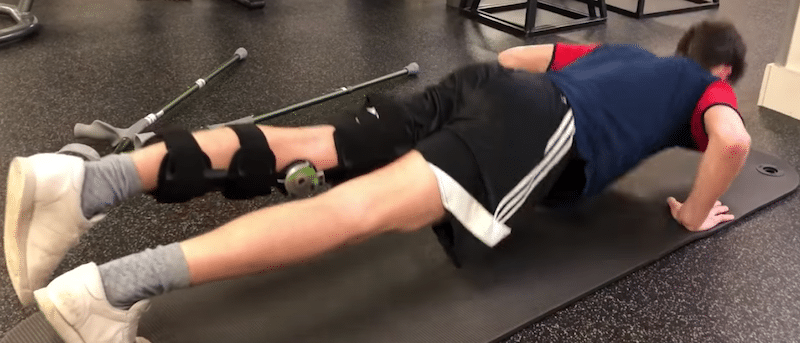
I would like to tell you more about my anterior cruciate ligament and the revision by orthopaedist Cor van der Hart. I hope this will help you make the right choice for surgery and recovery.
1e surgery on my cruciate ligament
What preceded: 13 years ago, I previously had a reconstruction of my anterior cruciate ligament. This tear was caused by a wrong landing during a volleyball smash. This surgery used my hamstring tendon to replace the cruciate ligament.
After this surgery, I actually never trusted my knee again because it seemed that the new cruciate ligament had more play than the original one and the knee was thus less stable. As a result, I basically only did fitness and safe sports like cycling and running.
After three years, I was tempted by a game of tennis. This went well for 15 minutes and then I was already going through it again with a few accompanying curses. Had I now let myself have surgery for nothing? Was the cruciate ligament torn or stretched again? Is this the orthopaedist's fault, the physio's or my own (I have always continued to train my supporting muscles anyway)?
After this happened, I did not investigate further and decided not to do any sports requiring rotational movements. I did not even want to know if the cruciate ligament had ruptured again because I did not feel like entering into another 9-month rehabilitation, especially when success is thus apparently not guaranteed after this surgery.
For ten years I went on like this, and because of my caution things didn't actually go wrong again, but the result was that my healthy leg became much stronger and took over far too much. This occasionally caused some mild back pain, but it was not bad enough to do anything about it.

Suddenly, things were well and truly wrong
However, everything changed last February in Costa Rica. During a short descent on the country's most difficult trail, I slipped and went through gigantically. How I then made it back with a stick and a cloth tied tightly around my knee is almost a mystery.
The week that followed opened my eyes. I was in the most beautiful country in the world and I was sitting there with a fat knee doing nothing while I am originally a sports nut. I felt like I was the owner of a Ferrari but I was not allowed to drive it faster than 80. Besides, I didn't want to go through it more often which could damage my meniscus and/or cartilage. That's when I decided to hit the medical mill again.
FC cruciate ligament & Facebook
First of all, I posted a search message on my facebook for the best orthopaedist and clinic. There was a flood of responses about the best orthopaedist but also trainers who would make sure I could do everything again without surgery.
Getting a stable knee through training is not something I believed in, especially given the considerable instability in it. It really depends on the build of your knee and even if it works, there is still the risk that you will forget to tighten your muscles at a crucial moment.
The orthopaedist who was mentioned very often was Cor van der Hart. I had heard of him before and after reading about him, my confidence grew even more. Most of the good information I found was on the site www.fckruisband.nl Through a connection at the Topsportcentrum Gelderse Vallei in Ede, I was quickly able to contact Cor.
The MRI scan
The MRI showed that almost nothing was left of the cruciate ligament, and not much could be seen of the cartilage and meniscus, but more could really only be said about that during surgery. Cor did functional tests with the knee and felt how unstable it was. He even brought in an intern to feel it, because the slack was remarkably large.
Cor also did not believe that this knee could be stabilised by training. He suggested doing a revision and using the patellar tendon this time, and what was new to me was that he wanted to make an additional reinforcement, an ALL augmentation. This second one in particular was music to my ears, as it might start to give better results than the failed reconstruction 13 years ago.
What I did think is, "Why didn't I read about this on the internet? Imagine if I had ended up with another orthopaedist, I wouldn't have known about this." However, Cor did say, "Your first chance is your best chance". Hmm, I didn't like hearing that as much, but my gut was telling me to do it anyway.
I also asked Cor about the results of artificial cruciate ligaments and lars ligaments. These appeared to be intended only for acute surgery just after an initial tear and not suitable for revision. Moreover, bodily material would probably not wear and age as much. This I found unfortunate because rehabilitation then often goes a bit faster and I had already spent 9 months in rehabilitation before, which unfortunately proved futile in retrospect.
Cor even said that the latest research showed that a year of rehabilitation had an even higher success rate than 9 months. The biggest problem for me was the 6-week period on crutches, because my own business and work would suffer. I often give lectures and teaching days for groups and that long standing is very difficult, especially when you get complications. However, the crutches-free phase that follows may last a long time from my point of view, because I am not an elite athlete who needs to start playing more matches as soon as possible.
Ok, I want to get off those crutches as soon as possible and then the slow protocol please. My wish was then 5 Dec 2016 to get a reconstruction with ALL augmentation as a St Nicholas present from Cor. And the wish was granted.
Preparing for surgery
Two months before the operation, I wanted to talk to the physiotherapist beforehand. Bergmankliniek recommended Hylke Hopmans of Fysio Holland in Amsterdam. I immediately made an appointment to see what I could do in preparation.
Hylke looked at my knee and muscles and said the most important thing was not to go through it again. The muscle strength and mass was sufficient and the knee was quiet with no major fluid build-up. What was abundantly clear is that I use my operating leg much less than the "good leg" and that that was going to be a very important focus during rehabilitation.
In the week before the operation, I went to Hylke once more to practice walking on crutches and to go over the rehabilitation protocol. I was also given some exercises to do immediately after the operation.
The most important thing was to get the stretching right right away and, in addition, immediately practice being able to tighten the medial head of the quadriceps. This seems to be a problem right after surgery.
My anterior cruciate ligament reconstruction
5 December was the day. I was able to report to the Bergmank Clinic at noon only to be operated on two hours later. I was immediately taken to my room. A private room, wow, what a luxury! Last time, I was in a room with six in a regional hospital.
At a quarter to two, I was picked up on my bed and taken to a reception room with three other patients. There I was given a drip and on call we could go to our doctor. Ten minutes later, Cor was ready and it was my turn to be wheeled into the operating theatre. There, I was given an epidural without any further intoxicants, as I wanted to be able to watch as clearly as possible on the screen. The epidural worked quickly and Cor was able to get to work.
All sorts of things were happening that I didn't understand, but after ten minutes the screen started showing pictures. Cor explained everything to me during the operation, which I really liked, especially because I could ask questions right away. Soon I got answers to my most important questions: "The cartilage is intact and the meniscus looks good". This was music to my ears and I immediately had a smile from ear to ear. He put the new cruciate ligament and all augmentation together and the operation was successful, I had a stable knee again.
He gave me another hand and I saw that sweat was on his forehead at an antibacterial temperature of about 15 degrees, so hard work this job. I was taken to the recovery room where I was kept under observation for another half hour. I was also given a groin injection to ease the pain of my all augmentation for the next ten hours. When everything turned out fine, I was taken to my room for the rest of the day and night. The epidural would wear off four hours later.
Recovery after surgery
Arriving in my room, I immediately began my "it doesn't hurt, it doesn't hurt" protocol.
I took daily for support:
- 2000iu vitamin D
- 2 grams of vitamin C
- 400mg magnesium citrate
- arnica pills (VSM).
Other than that, I kept my standard "Hormone Factor" diet:
- gluten-free
- lactose-free
- casein-free
- and eating unprocessed food is the way for me to keep the inflammatory activity in my body as low as possible.
Other points of interest:
- Moreover, I wanted to don't eat too much, so that not too much energy would go to digestion and that I would not gain unnecessary kilos that I have to lug around during rehabilitation. That way my immune and repair system keeps as much energy as possible for the recovery my knee is my vision.
- Furthermore, I got natural medical painkillers and anti-inflammatories prescribed. I don't like that but in this case I actually had to. However, I tapered these off after four days as the pain subsided and the anti-inflammatories were able to do their job properly.
- What I did continue to use are the thrombosis syringes (fraxiparin), because of course you don't want thrombosis. What I did regret is that these thrombosis injections inhibit vitamin K and thus also the growth of the bone pieces, but well, you don't really have a choice in this situation. Doctor Van der Hart said it is indeed a choice between two evils and that thrombosis is something you should always prevent. The bone grows well in six weeks even with the use of these injections.
- When the epidural wore off I immediately started the tightening of shins and calves by pulling my foot towards me and then pushing it away from me again.
At 20h in the evening, I received an email from Dr Van der Hart with the knee photos from the surgery. Wow, so he doesn't have a nine-to-five mentality. My legs were well stretched right from the start and I deliberately kept them that way, even during the night in the night brace.
The next morning, the physiotherapist from BergmanKliniek came to see if I could safely walk with crutches and was ready to go home. Cor van der Hart also came to see how I was doing. What came up briefly was that he noticed that I had already passed 40 by the fact that the bone tissue was slightly softer than a 20-year-old footballer, but that would not cause any problems in recovery.
Walking actually went well immediately so I was allowed to go home. What I did notice was that I saw some white in my face and I felt a bit lightheaded when I stood up. Logical too right after surgery and with maybe a slightly lower haematocrit value due to the surgery and let's not forget the painkillers too, may I epo?
I was fitted with a knee brace as extra protection outdoors and it was set at maximum 70% flexion.
My rehabilitation, fairly quick recovery time
The first week
For the first week, I had planned to stay on my bed as much as possible and do the exercises from there alternating with Netflix. I only got out for toilet, bathroom and physio visits. I was overjoyed that my friend had the time and inclination to look after me optimally for the first few weeks. I obediently took my planned high-dose supplements (vitamin C,D and arnica pills) and I ate very healthy meals prepared by my girlfriend.
Two days after the operation, I went to see my physio Hylke Hopmans at Fysio Holland for the first time. Hylke thought it all looked good. The stretching was complete and I could already bend almost to 90 degrees. Bending seems to be very difficult with an all augmentation and the first phase can take 2 weeks longer sometimes because of this.
I practised moving the leg safely in a stretched position when climbing on and off something to avoid putting unnecessary stress on the cruciate ligament. In addition, I trained the medial head of the quadriceps without weight. On the edge of the bench, I could start "dangling" to improve and ease the flexion possibly with a coldpack to cool at the same time. I was also given exercises to lift the leg backwards and sideways with increasing load. I could work on these from my bed and that's how I got through the week.
The second week
In the second week, I started expanding my walking and improving technique. Point of attention was that I need to start loading my operated leg as much as the other and especially when standing still. When brushing my teeth while standing still, for example, I have been unconsciously leaning on my good leg for years and that needs to be rammed out.
This week, the quadriceps started to get noticeably stronger and during the run, a nice stretching and foot settlement was already emerging. What I did notice about my peers in practice is that they often had more swelling and blueing of the leg and progressed more slowly than me. Perhaps I was lucky or my nutrition and supplementation plan really works.
Even the all augmentation did not seem to slow me down. In addition to the physio appointments, I took longer and longer walks in nature. As soon as I noticed that the technique started to deteriorate or fatigue set in, I stopped.
Many exercises I was able to do standing during my round and it is very motivating to be able to do this in the open air, as the walls were starting to creep up on me a bit at home. By the end of week two, I could walk for 30 to 45 minutes with crutches without any problems. Strangely enough, my knee did not react to this at all with swelling or pain, which is obviously very nice, as I read other stories about this too.
I only have a little fluid accumulation in the knee itself (especially around the all augmentation) and not at all in the rest of the leg. This week's physio sessions also went very easily with me, although I was still regularly corrected to keep a proportional load on my weak leg.
The third week
Early in the third week, my stitches were allowed to come out. A wonderful moment that was. The plasterer at the Bergman Clinic saw how well it was going and asked if I wanted another brace. I thought this was totally unnecessary as I felt I was already too far advanced. Hylke happily agreed. After all, I found the brace quite irritating.
In the third week, the load has already been scaled up quite a bit and I got to go on the exercise bike for the first time. I expected a lot of it because in my knee could already bend 120 degrees after warming up. I started with ten minutes on a bike without resistance to see if the pedals went round nicely and if I didn't get a backfire afterwards.
After two weeks on the exercise bike with an all ligament is very favourable as this only works out after four weeks on average said Hylke. My knee turned out to have no problems with this cycling session afterwards and so we could start cycling under small resistance and I was allowed to expand this daily in terms of duration.
For the rest, the motto now was to continue in a relaxed manner and focus on the proportional use of my operated leg. The bone pieces really need six weeks to grow together, so pushing will do more harm than good.
The fourth week
In the fourth week, I felt my leg getting a bit stronger and more stable. I was tempted to throw away my crutches, but I really had to restrain myself from doing so. I had already built up the cycling to 30 minutes and from now on I was allowed to add a bit of resistance every week.
Furthermore, my training was consolidated actually, as I was ahead of schedule, and there is simply no mocking ingrowing bone tissue. This was quite difficult for a fanatic like me, but fortunately I could use my energy more and more in cycling.
To my mind, my gait pattern in terms of muscle strength and coordination was good, but the feeling of a stiff "sticky" kneecap threw a bit of a spanner in the works so I did not yet have the same unconsciously competent running style I had before surgery.
I was hoping that that kneecap would start running resistance-free soon. However, Hylke said this could take about three months. This week, I already went shopping again for a few hours and watched the NK skating. This went fine and the knee did not react to it, even though I stopped putting my leg on a raise in between.
The fifth week
The weekend preceding this week was New Year's Eve. I deliberately avoided the big crowds and took virtually no alcoholic drinks. The champagne would not open for me until a few weeks later because by then the bone fragments should have officially grown in, and that is worth a celebration, of course.
Besides, my sleep is sacred to recovery and so I slept in at 1.30 a.m. and was out reasonably in time to exercise of course. For a while, I loosened up my knee on the exercise bike and then went for a walk.
To my delight, the sticky feeling in the knee was gone, and so I was suddenly walking a lot nicer. I also tried how it went on flat stretches without crutches and actually it felt fine.
For the first time, I also noticed that my knee had more firmness than before the surgery and that gave me confidence. Actually, I felt the all augmentation much more than the cruciate ligament reconstruction itself. So the first physio session of the week went very well. I was allowed to do weightless squats with something like 70 degrees of flexion and sun salutations every day. This seemed like a real workout.
I also started serious strength exercises for my upper body again this week. At the end of week five, I was due to do my first reading again. It was a major aim of the first five weeks to be able to do this again, but everything seemed so cooperative that this should be a breeze. And yes, it went fine.
The crutches were along to keep people in the crowds a bit away from my knee and on stage I stood without crutches. Afterwards, no reaction from the knee so that was nice!
The sixth week
Above all, I had to be patient this week. Rehabilitation went well, but it takes at least six weeks for bone tissue to grow. I was allowed to do the squats with a 10 kg disk and try to do 70% with my operated knee. This was not easy, as I had been relieving this one for a long time and when squatting, my lower back automatically steers towards the strong leg. So the movement was: first lean the hip towards my operated leg and then lower it.
Cardio was extended to include unloaded sessions on the cross trainer and I was also allowed to go for walks without crutches in quiet areas of twice 15 min. I also started doing light leg presses, adductors, abductors and an almost unloaded leg curl to train the movement. I felt that I should be able to do a much heavier leg curl because my hamstring tendon had not been used in the surgery. Yet Hylke advised me against this, because it was not so much about the hamstring alone, but also about the knee capsule that still needs to adapt to this movement.
Moisture was still quite a bit in the knee, especially around the all augmentation. It was recommended to cool a lot. I did, but my knee did not really seem to thin out as a result. However, my knee was slightly thinner in the morning than in the evening.
End of week 6 was a big test. Two days of standing in front of the class. Fortunately, my knee could already handle this, so I felt the hardest part was over. During the breaks, I obediently did the exercises Hylke had given me to keep the knee supple, because standing for long periods is simply not ideal.
The restrictions in daily life were no longer there. Of course, though, the toughest training part was yet to come when I was allowed to load more, but training heavily is more of a reward for me as a sports fanatic.
The seventh and eighth weeks
During these weeks, it was sometimes great and then less so. Depending on my activities and standing hours, the knee was either quiet or somewhat swollen. I sometimes had swelling 1 (you can move the fluid, but you have to push it back) and sometimes swelling 2 (it flows right back by itself), as physios say so nicely.
What was also unfortunately not so nice was that cinema visits also negatively affect the knee. Somehow, the position in a cinema seat is not so nice and the knee starts to "nag" a bit after 45 minutes. Normally, the swelling goes down a lot after a month or two, but experience says that in a revision leg with ALL, this can take significantly longer.
The third month
This month was already getting a lot more fun. It was working towards running on tape and later outdoors. That did me a lot of good, because I love running. It was admittedly with a bit stiffer leg than usual, but once warmed up, it went quite well.
In terms of physio exercises, I had a lot of trouble with a one-legged squat and especially the ALL and the spot where the patella tendon was removed were very sensitive. The rest of the exercises went quite well and I had to restrain myself from aggravating too much.
The fourth month
In this month, I started training significantly heavier and sometimes I came back really broken. Squat was already going at 60 kilograms and bulgarian lunge (back foot on elevation) was started.
Light jumping elements were also introduced in preparation for the weekly outdoor training with the cross-trainer group. At this outdoor training, exercises and games were done together to improve coordination and fitness. The first weeks I found it terrifying. Especially the things that were done on one leg.
The fifth month
Now things got really serious. Squats were already going at 85 kilograms and coordination exercises (ladder) were getting harder. Rope jumping in all kinds of forms, skating jumps and even the first twisting movements during jumping came in.
The trampoline was also used. This actually did not even disappoint me, so this did give a kick. What still proved difficult was the one-legged rope-jumping and the sideways hopping. This was still done with a too stiff leg and I was given homework to do this a lot, also during the running laps I did on my own.
I realised that I had not dared and done this kind of exercise for more than 10 years. In outdoor training, I was already doing sprints and the exercises that came with them went well for me. I have an athletics past and apparently you never forget that.
At the end of this month, I had a really nice moment, which was walking into the surf for the first time on the beach. Before the surgery, my lower leg looked like it was hanging on a pair of rubber bands when I lifted my leg. If a wave hit it at that moment, the knee felt very unstable. This time, it was completely different. My knee felt completely "solid", and this had not been the case before (even after the first surgery).
The sixth and seventh months
During these months, progress was actually slow. Actually, this was a transition phase to the difficult and heavy exercises and that meant my knee reacted a bit at times. In particular, the place on top of the kneecap where the patella tendon had been removed remained sensitive. However, I was back to cycling and running 5 km every week. When I had a busy working week, this sometimes didn't happen and I immediately noticed the symptoms increasing, rest rusts....
The eighth and ninth months
In these months, things got really serious in terms of training. I must say I was already in good shape in terms of strength and fitness. Squats were already going with 100kg and bulgarian lunges with 60kg on my neck. Hylke also said that this was no longer a focal point but that we were going to do everything we could to optimise coordination and start daring more again.
Exercises with jumps and turns became more and more important and in month nine I could even hopscotch with a turn over hurdles 15 cm high. I still found this terrifying, though. Training actually became more mental than physical. I did all kinds of exercises that I never did in my first rehabilitation. I now really rehabbed as an athlete who wants to become 100% again and I was very happy with that.
The tenth, eleventh and twelfth months
From the tenth month, things slowly progressed still. Actually, I was pretty much done with rehab after nine months, but I was reimbursed for a year of physio by insurance so I was happy to fine-tune.
This period also saw the final tests scheduled by physio Holland. A strength test and a combined test of all elements in the hall. In the strength test, I managed to be only 10 per cent weaker in my operated leg, which was fine, especially considering that I used mainly my "good leg" for more than 10 years and that it is a "revision leg".
The combined test also went well enough and so my physio course at Fysio Holland was finished. I was given tips on how to keep it up, though. When your stick in the door in the form of physio appointments drops away and you no longer do your exercises diligently, your results naturally deteriorate. That's why Hylke tries to train his athletes to more than 100%, so to speak, because in practice the result in the period afterwards can decrease slightly because of this. I was given advice that suits my situation and sport and I obviously intend to follow it.
In addition, the knee will also recover some more after a year. In particular, the area where the patellar tendon was removed may remain somewhat sensitive for often a year and a half after surgery. Also, the nervous system will take even longer to really get to know the "changed" knee. In fact, this "proprio scepticism" adaptation will take up to more than two years, according to the latest studies.
All in all, I knew beforehand that the knee would never be 100 per cent again, but I am more than satisfied and hope to enjoy the knee that has become stable again for many years to come.
I would like to say a big thank you to orthopaedist Cor van der Hart and physiotherapist Hylke Hopmans. It was a year in which I had to invest a lot, but I got a lot in return. Without also your one hundred per cent effort, this would never have been possible. It was more than worth it!
With sporting best wishes, Ralph Moorman
 English
  Dutch
Dutch 
1 Response(s), post a comment too!
Thank you for sharing your experiences, that helps me to be full of
For my vkb recovery to go after surgery ( i.c.w. Meniscus suture )
By Dr van Dijk Bergmans Clinic Breda. Regards, Erik