
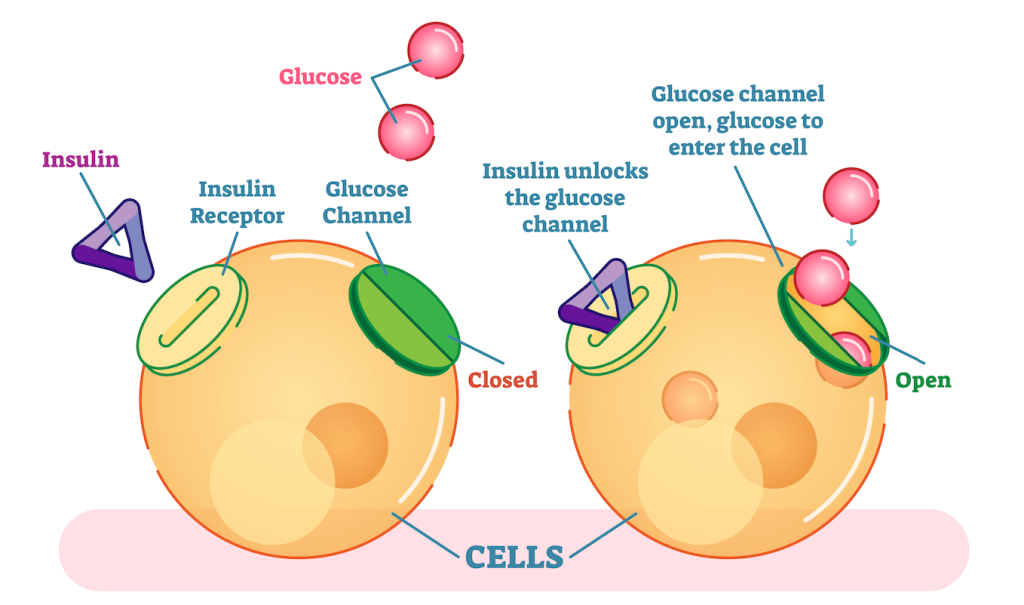
If I mention it in my lectures and training have over insulin, then I often notice that this hormone has a very bad name. For instance, insulin is often thought to be a fattening hormone. Somehow I can understand this too....
Why you think insulin is fattening
- Insulin is an anabolic hormone whose functions include helping to store glucose not only as glycogen in muscles and liver, but also as fat in fat cells.
- It is also notable that people who are overweight often have high insulin levels in the blood due to insulin resistance.
- On top of that, when people insulin resistance often get it harder to lose weight.
- To top it off, it is also the case that people who do a lot of carbohydrates and sugars food start retaining a bit more fluid and thus being kilos heavier on the scales.
This can easily create the misconception that insulin would be causally linked to storing more fat. As you may already know, in scientific 'association' is certainly not necessarily 'causation', or cause.
Scientific 'association' not necessarily 'causation'
- First, it is important to realise that insulin has several functions. Insulin keeps blood sugar from rising too far by stimulating glycogen storage in liver and muscle. When insulin stimulates storage as glucose in fat cells, you have to realise that the calorie balance is leading in this. So you then have to eat more calories than you consume and fat cannot suddenly appear out of nowhere.
- In addition, not only does eating sugar and carbohydrates raise your insulin but also when you eat proteins eats. In fact, insulin also has a function in protein synthesis in the muscle cell, among others, i.e. muscle growth. This makes insulin the most anabolic hormone the body produces, as it can stimulate storage of glycogen, fat and protein. In the hardcore bodybuilding world, insulin is even sometimes used (abused) to become even more muscular.
Why does insulin have a bad name in relation to obesity?
High insulin levels common in people with overweight are caused by insulin resistance. This is mainly a consequence of obesity (plus inactivity and stress) and precisely not the cause. But once insulin resistance has developed, it does become a lot more difficult to prevent further gain or even lose weight.
When there is insulin resistance, blood sugar is less well regulated. The risk of developing blood sugar dips is increased. Due to blood sugar dips where there is a lethargic feeling and lack of happy chemicals, people are a lot more inclined to reach for high-calorie snacks full of sugar, fat and salt. So it then becomes more difficult to reduce calorie intake.
Low carb diet - Slow carb diet
- One method to reduce the risk of blood sugar dips in people with insulin resistance is a 'Low-carb diet' (low carb diet). Since many people worldwide have insulin resistance, it has become very popular. This makes it easier for them to maintain calorie restriction. However, what can confuse people when following a low-carb diet is the number on the scales. Restricting carbohydrates can make you lose a few kilos of fluid or gain weight when you take a break from being strict with yourself. This can cause people to become unnecessarily afraid of carbs when they want to lose weight. This, while if it's just about preventing blood sugar dips you don't necessarily need to eat low-carb.
- You can also choose high-fibre carbohydrate sources that allow blood sugar to rise slowly. When blood sugar rises slowly, the chances of blood sugar dips are low, even when someone is insulin resistant. This would also give you a 'Slow carb diet' (slow carb diet) could be called. If you manage to lose weight permanently, exercise and train more and reduce stress, insulin resistance can reduce or even disappear.
Insulin a fantastic multifunctional hormone
My conclusion is that insulin is a fantastic multifunctional hormone that we should look at with reverence. It is important that this hormone can function properly by preventing insulin resistance. Insulin resistance makes losing weight more difficult, but that is not the fault of insulin, but the more difficult limiting of calorie intake due to blood sugar dips. Calorie balance is ultimately leading the weight-loss process again. Insulin does not make you fat, but a positive calorie balance does.
Read my column on Ozempic here: Ozempic for diabetes or as a weight-loss pill?
 English
  Dutch
Dutch 
2 Response(s), post a comment too!
Interesting story about insulin!
But what about if you don't have high insulin spikes, but keep having too low spikes after eating?
Would like to know how that goes and what to do about it.
Hey Yvonne, if it is medical hypo-insulinaemia, this is an issue for a medical specialist.
yours sincerely Ralph Moorman