
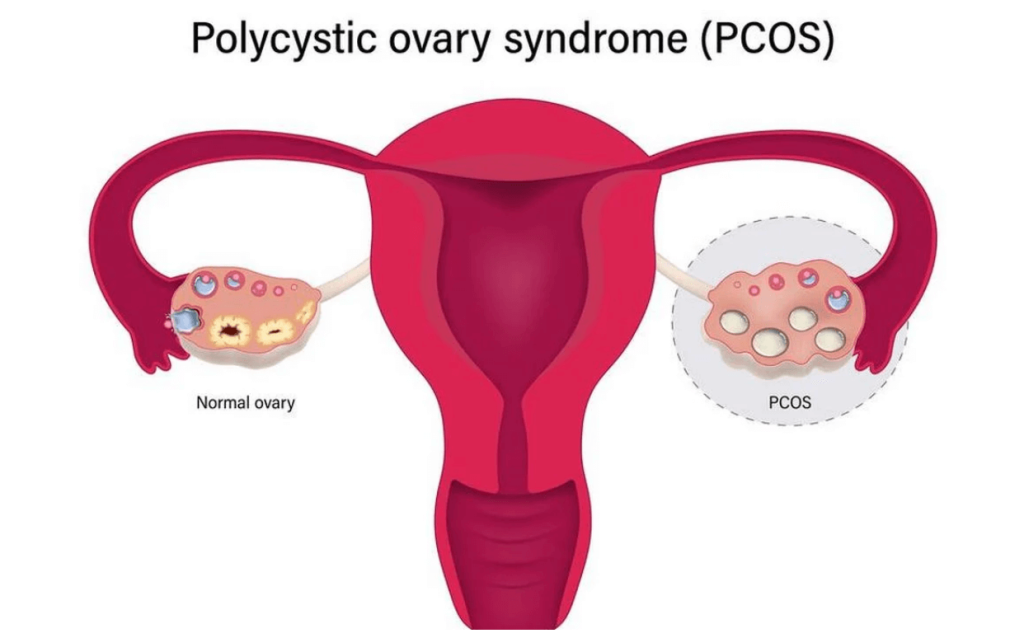
(Lean) PCOS is a syndrome that is very common in women of childbearing age.
(Lean) PCOS is a syndrome
This means that there are characteristic clinical signs but no single cause is known. The three symptoms used to diagnose PCOS are:
- an irregular cycle (fewer than 9 menstruations per year to no menstruation at all and therefore less likely to have conceive)
- cysts on the ovaries (seen on ultrasound)
- and increased production of male hormone (excessive levels of testosterone and the pituitary gland hormone LH).
At least two of the three symptoms must be present before you are diagnosed with PCOS.
Hormone treatments and contraceptive pills...
Fortunately, more and more is becoming known about the subject and the taboo on it is becoming somewhat less. It is also becoming increasingly clear that in PCOS, in addition to a genetic component, there is a lot of influence from diet and lifestyle.
Unfortunately, many women's doctors are still too clueless about this. Many women are still told by the doctor that they can start taking the contraceptive pill and if they want to try to get pregnant that there are other hormone treatments are what they can come back for. If any nutritional advice is included, it is about losing weight, as the majority of women with PCOS are also overweight.
- First of all, I think this is a missed opportunity, because there are many more influences from lifestyle than just losing weight, and losing weight in severe obesity is very difficult without the right (mental) coaching.
- Second, you pass over a large group of women with PCOS who are not overweight at all, which is also known in the international scientific literature as 'lean PCOS' is called. For this group, losing weight will not be too solution.
The Homa-Ir value (insulin resistance
Yet there is a striking similarity between overweight women and slim women who have PCOS. Indeed, in research, both groups suffer from insulin resistance. The Homa-Ir value, which is a measure of insulin resistance, is too high in both groups (1).
In practice, it often turns out that women suffer less from PCOS when they gain higher insulin sensitivity through nutritional and lifestyle intervention.
Lifestyle causes that may lie beneath insulin resistance are:
- overweight
- eat too often
- eating too many meals that the letting blood sugar rise too fast
- increased inflammatory activity inside the body
- inactive life and chronic stress.
So there is very much to be gained by improving diet and lifestyle in the broad sense. Often in PCOS, losing weight will be a major focus, but in slim women with PCOS, the focus will have to be more on addressing the other causes. In addition, supplementation can also do something. For instance, supplements with inositol (myo-inositol and d-chiro-inositol) seem to be quite effective, especially in slim women (2).
 English
  Dutch
Dutch 