
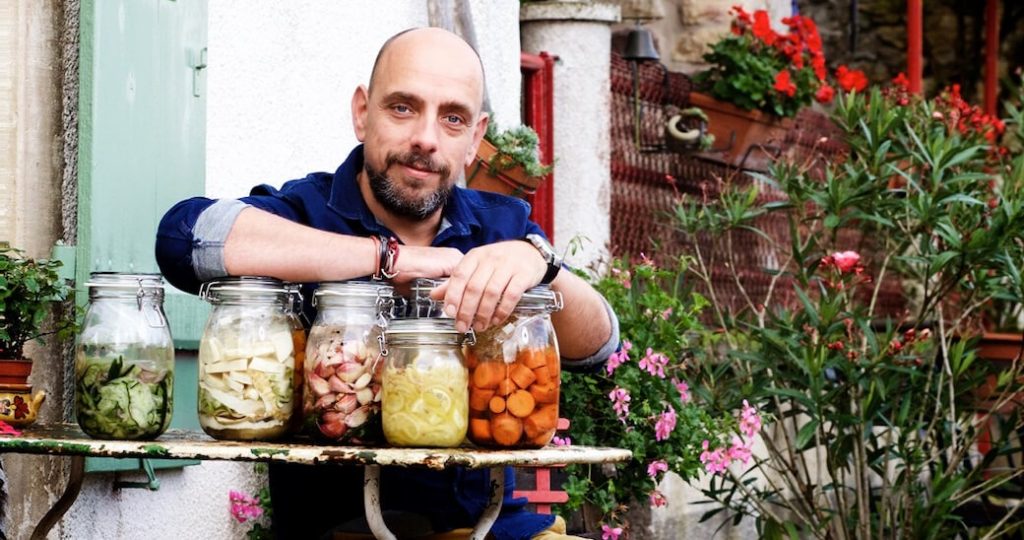
Fermentation is becoming increasingly popular. To specialist Christian Weij I ask some questions that often come up so you can learn to ferment.
What is fermentation?
The meaning of fermentation is changing edible products through bacteria, fungi and yeasts.
Why do we ferment food?
We ferment food because it makes it last longer, or tastier, or more digestible, or healthier, or edible anyway. Often it is a combination of these reasons.

Learning to ferment: how do you do it?
Step by step:
- Put the rubber ring around the lid of a bracket jar (this prevents oxygen from entering the pot during fermentation and allowing the vegetables to go mouldy).
- Cut, shave or grate vegetables (e.g. cabbage) into thin long strands.
- Put the vegetables in a large bowl. Weigh it and add 1.5% of salt (so on 1 kilo of vegetables, 15 grams of salt). The salt kills unwanted bacteria, allowing lactic acid bacteria to multiply and turn the vegetables sour.
- Knead the vegetables and salt together until a layer of liquid forms at the bottom of your bowl. Not enough liquid coming out? Then you're not squeezing hard enough.
- Spoon the mixture into a bracket pot. Fill the jar to 3cm below the rim and press down well. There should be no air left between the vegetables and when you press it, moisture should rise above the vegetables.
- If necessary, put something heavy on top of the vegetables so it stays under its own moisture and close the jar airtight.
- Put the jar on your countertop and let the vegetables ferment for seven days at room temperature. After seven days, open the jar for the first time and taste. Is it fresh and nicely sour? Then it is ready. Use it immediately or put it in the fridge and eat it within eight weeks. Still don't think it's sour enough? Then let the vegetables ferment further for a few days at room temperature.
It is a fable that you cannot ferment garlic. If it turns sour, it is always safe to eat.
Is self-fermentation safe?
As long as the product turns sour (a Ph lower than 4.5), it is safe to eat. The nutrition centre mixed up fermenting and maceration. In fermentation, the product does not become acidic and can therefore go wrong. Prof Dr Eddy Smid showed The Nutrition Centre all kinds of studies showing that fermenting fruit and vegetables is super safe.
Buying a healthy fermented drink
There are several fermented drinks. I can give you '7M Probiotic fermentation concentrate Bio' recommend. This fermentation drink has been tested by Juglen Zwaan (aHealthylife). It has a huge diversity of benign bacteria, local organic herbs, active lactobacilli (28 strains, at least 15 billion benign bacteria per 5 ml), and is free of sugar, dairy, gluten and alcohol.
7M Probiotic fermentation concentrate
4 questions on salt:
- Why do you use salt? -> To kill unwanted microbes.
- How much salt do you use? -> At least 1.5% based on the weight of the vegetables.
- Which salt do you use? -> Any kind of salt will do.
- Is fermentation possible without salt? -> No. If you want less sodium, use potassium salt.
At what temperature do you ferment?
Somewhere between 16°C and 28°C.
Should you store fermented food in the fridge?
When it's ready, it doesn't need to be refrigerated. But... if there is still sugar in the vegetables, the lactic acid bacteria will convert it into lactic acid, making the vegetables even more sour. If you don't want this, you can put it in the fridge.
What are the top 10 most common products to ferment?
- Vegetables
- Fruit
- Coffee
- Tea
- Chocolate
- Meat
- Fish
- Wine
- Beer
- Dairy
Other examples of fermented foods include: sauerkraut, pickles, water kefir, milk kefir, kombucha, bread, crème fraîche, cheese, yoghurt, butter, vanilla, olives, pepper, dry sausage and tabasco.
What are the top 10 vegetables to ferment?
- White cabbage
- Chinese cabbage
- Carrots
- Pickles
- Pumpkin
- Beets
- Onions
- Turnips
- Kohlrabi
- Cauliflower
What are the 2 most common mistakes when fermenting?
- That oxygen can get to it causing vegetables to go mouldy.
- Too much salt so nothing ferments.
Why can fermentation be healthy?
- Door te fermenteren wordt voeding makkelijker verteerbaar. Bij het langdurige fermentatieproces van brood (echte desem) worden fructanen (FODMAPs) vrijwel volledig afgebroken waardoor sommige mensen met prikkelbare darmsyndroom minder klachten hebben (FODMAP-dieet). Ook wordt een deel van de aanwezige gluten afgebroken waardoor sommige glutensensitieve mensen het beter verdragen. Let op: glutensensitiviteit is wat anders dan coeliakie. Bij coeliakie is standaard desembrood een absolute no go.
- We also find the bacteria that take care of fermentation in our intestines, called good gut bacteria or probiotics. Fermented food can therefore improve gut flora.
- Prolonged fermentation breaks down all kinds of unfavourable substances. These substances are also known as anti-nutrients. Well-known examples of anti-nutrients are phytic acid and lectins.
- The fermentation process can also produce healthy substances such as vitamin K2 and B12.
Are there people who do not respond well to fermented foods?
When you lack enzymes or bacteria that can break down certain substances if your microbiome is out of balance - that is, you have the wrong mix of bacteria - you can get a leaky gut that can trigger the immune system (unnecessarily).
In that case, you have elevated histamine levels in your blood indicating low-grade inflammation or allergies. Some fermentation bacteria produce histamine which can make the complaint worse in these people who already have elevated histamine levels. By no means all fermentation bacteria increase histamine levels, by the way.
If you are hypersensitive to flavour enhancers consisting of free glutamates (such as E621) then some fermentation products can cause complaints. For example, free glutamates are also created when fermenting soy into soy sauce. For flavour, this is actually desirable, but if you can't stand it, it is obviously undesirable.
Would you like to tell us something about your workshop?
Fermentation has been such a big part of our diet and it still determines many of the flavours we have. Because of this, lots of different audiences are attracted to it. People who have a kitchen garden, people who love cooking and want to learn something new, people who want to eat healthier, people who want to find something we have lost, people with memories of fermenting grandmothers and want to be able to do it themselves, and cheesemakers, brewers, bakers and chefs looking for new flavours. And all these groups come to me.
I run workshops for beginners to advanced fermenters. I give guest lectures at many catering schools and have taught staff fermentation at many restaurants. This ranges from bistros to restaurants with 1 and 2 Michelin stars.
Interested in a workshop? See the agenda here.
Who is Christian Weij?
Christian is a food designer, chef and fermentation expert and author of The first Dutch fermentation book 'Verrot Lekker'. A book full of tasty recipes and including a handy list of 'fermented foods'.
 English
  Dutch
Dutch 
10 Response(s), post a comment too!
Hello, I want to make orange vinegar but forgot to buy baker's yeast. Can I replace that with something else?
Thank you very much!
I left the fermented vegetables in fridge for about 3 months. Is it still good then? Can the wrong acids form?
Good afternoon,
I fermented red cabbage with apple. For the first two days, I had enough moisture and the cabbage was under the moisture. But later the moisture disappeared. Is this normal? It still smells and tastes good.
Regards. Gerrie Schinkel.
Ferment your fruit varieties with salt too
Good evening, can fermenting water and drinking it all day do something wrong so you can get an allergy from it ?
Hi Ralph, I forgot to put the cabbage completely under moisture/water (1st x myself). Does it ferment well then? Deployed it a fortnight ago. Is it edible or do you advise against it then?
I would like to ferment garlic (I assume kneading then won't work as the cloves will break?). I found a recipe with 12 bulbs, 2 tsp salt, 2 tbsp whey and 125 cc water. Of course, it takes a while for everything to sour enough. Between the start of the process and it being acidic enough, can't botulism develop that could still hurt then? Or will all possible botulism be killed off again when it is acidic enough? (I find that part the scariest I believe)
After fermenting, should you leave the vegetables in the liquid? Or rinse off?
Fermentation course
Fermentation without salt possible if there are/is enough lactic acid bacteria (starter), this in a reasonably clean environment of course, try apples under hand blender (without stone/stem) with water, will ferment, become sour, alcoholic, & eventually vinegar
Salt kills wrong, but lactic acid bacteria also willing to fight