
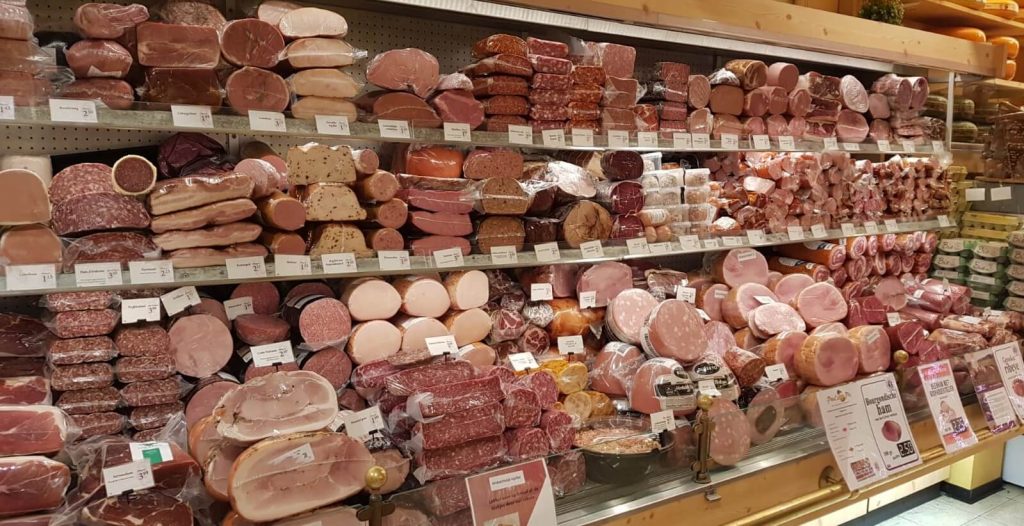
Ever wonder why the meats in the shop often look so beautifully red? Without unsavoury brown discolouration?
Adding nitrite
This is because nitrite (E250) is added to it, a substance that colours the meat red, makes it safer and longer lasting. And which, unfortunately, can potentially be converted into the carcinogenic nitrosamine in the body.
Adding water-binding substances
However, these are processed meats, so a pure piece of steak often does not contain this (check the packaging). To make meat 'juicier', it is injected with water and water-binding substances (E450, E451) are added. Look carefully at the packaging: water-binding substances must be mentioned in the ingredient declaration. The same applies to the added water if it exceeds 5 per cent by weight.
5 benefits of organic meat
Organic meat has to meet stricter requirements than non-organic. This has a number of advantages:
- No added water.
- Reduced use of nitrite.
- Less chance of residual antibiotics.
- Reduced risk of antibiotic-resistant bacteria.
- Animals in organic farming are fed a one-sided (grain) diet; on organic farms, animals are often fed a more varied diet. This can lead to a healthier fatty acid composition of the meat.
However, there are also disadvantages to organic meat: more risk of parasites and because the animals graze more outdoors, their meat contains more dioxin.
Do processed meats cause colon cancer?
In addition, meat is also regularly seen in a negative light because of its association with, for example colon cancer. Do realise that the studies that revealed this were done with processed meats. Perhaps additives such as nitrite or processes such as excessive heating (creating burnt edges or getting smoke from a barbecue into the meat) are strong contributors and with unprocessed meat it is a different story.
Healthy substances in meat products?
Meat is an important source of protein with high biological value and contains many more healthy substances, such as easily absorbable heme iron, B vitamins, omega 3 fatty acids, creatine, carnitine, carnosine and taurine.
Who strict vegetarian or even eat vegan, must take this into account and partly rely on nutritional supplements to avoid harmful deficiencies. Meat can also be useful for proper hormonal balance, as its proteins and fats are important building blocks for your hormones.
Are processed meats bad for you?
Meat in moderation can be a fine part of our diet, but above all buy it unprocessed and use mild heating. In addition, lots of variety in the diet is always wisest so alternate with fish, poultry, egg and vegetarian. (1) (2) (3)
UPDATE: Nitrite-free meats
Fantastic breakthrough in (100%) safe shelf-life: Nitrite-free meat products.
As you may know, I studied Food Technology at Wageningen University with the aim of introducing more healthy products in supermarkets as an alternative to the overly processed unhealthy products full of sugar, fat, salt and experimental additives. During these years, I found out that there was little interest among companies for these products, for example because of too little demand from consumers at the time. The topic of health was mainly seen as something to 'window dress' to avoid negative publicity and not as a duty from an ethical point of view. Tasty, quick, easy, long shelf life and low cost were much higher on the priority list than true health. Of course, this is not something food technology itself is to blame. With technology, you can actually make products a lot healthier and it just depends on what purpose and conscience you use it for.
Thus, I share the main focus of my vision wherever I can:
Eat logically and as naturally as possible!
This may sound a bit crazy coming from the mouth of a Food Technology Engineer. I really don't think what we should go back into the woods in a bearskin and with a spear in our hand. What I do try is to translate the logic of nature to our current times and infrastructure. And this is precisely where Food Technology is indispensable. Think, for instance, about making products in the supermarket safe to eat. To avoid getting sick, you have to do something with food. This could be certain treatments, special packaging or adding preservatives.
Especially the topic of preservatives that worries me a bit. For instance, I'm really glad I don't get acutely ill after eating something, but what do these additives do to my health in the long term? We only know that they are not toxic to us in this dose, but what a cocktail of multiple additives does in the long term or what effect preservatives have on, say, intestinal flora is not really well researched.
One preservative that we haven't really seemed to be able to do without in the safe preservation of meat products yet in some meats, but where there are clear doubts about its effect on health is nitrite. For instance, it could potentially increase the risk of colon cancer. At the moment, nitrite is nevertheless used to keep the bacterium clostridium botulinum small. And that is just as well, because getting sick from this bacterium's toxins, or botulism, is something you really don't want.
But couldn't this be done differently I wondered. We can do so much these days with milder but still effective preservation methods. I took the plunge and approached Wouter De Heij. He is the director of Top BV in Wageningen, very health-conscious and a food lover. If there is one company that should be able to meet this difficult challenge in terms of mild but highly effective preservation techniques, it is this company. Wouter agreed that this would be an important healthy breakthrough and put the item on the agenda. This conversation took place about seven years ago and I am extremely happy that there is a breakthrough. The patent for safely preserving meat products without nitrite was born.
You can read it here: meat and meat substitutes safely preserved without nitrite
I hope the charcuterie industry will embrace this and that in the future only nitrite-free charcuterie will be in the supermarket. Wouter, I would like to thank you. You are a hero!
 English
  Dutch
Dutch 