
It is now 2025 and I still read the same explanations about the cause of acne on sites of hospitals and skin product manufacturers, namely:
Fighting sebum and bacteria
"Acne occurs because the sebaceous glands on the face, back or chest get bigger and make more sebum. When too much sebum is produced, the sebum accumulates and blocks the exit of the sebaceous gland. This is where bacteria then take hold and an inflammation occurs, i.e. a pimple."
In itself, there is a grain of truth in this, but when you read this you quickly think that you have to fight sebum and bacteria with all kinds of skin products and treatments, because you have little or no influence on it yourself with your lifestyle. I completely disagree. In fact, you do influence certain underlying processes that lead to acne with your behaviour. As far as we now know from research, it is about sebum production, inflammatory factors, overgrowth of acne-causing bacteria and hyperkeratinisation of pores. These processes are influenced by hormonal balance, food and lifestyle.

Real cause of acne
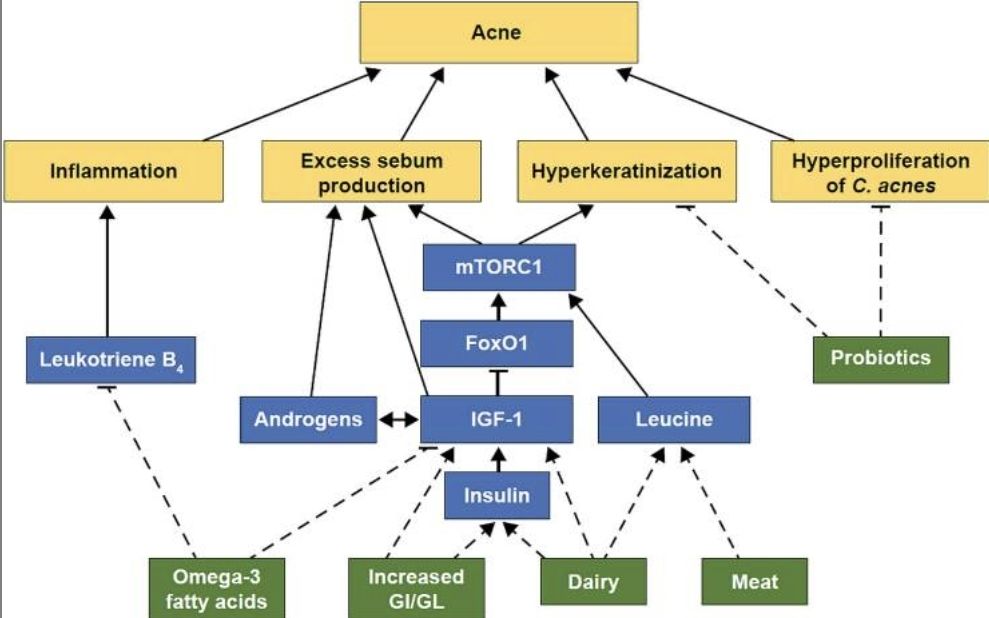
In 2020, researchers Hillary Baldwin and Jerry Tan have a nice review article made and a clear diagram. You can see, for example, the role of hormones free testosterone, insulin and IGF-1 (growth hormone) incorporated here, the influence of bacterial balance (gut and skin) and probiotics, as well as which influences from nutrition are important.
For example, many studies have described that hyperinsulinaemia (insulin resistance) and eating foods that cause blood sugar to rise rapidly increases the risk of acne. Indeed, when insulin gets high and blood sugar often spikes, free testosterone and IGF-1 will also go up and so will sebum production and hyperkeratinisation.
Ignition sources
The researchers also describe a possible role of dairy products. They explain this by the influence of dairy on insulin and leucine (hyperkeratinisation) as you can see in the picture. Personally, I think they explain the influence on inflammatory activity of dairy and other food sources you can be sensitive to such as gluten, nuts and egg on inflammations overlooked. So I would prefer to modify the diagram a little more on this part and give the influence of diet and stress on inflammatory activity a bigger role. Still, I think this diagram is a nice start to dealing with the topic of acne in a more nuanced and effective way.
Nutrition and lifestyle has, in my opinion, a much bigger impact on acne than scientists currently assume. Of course, this then requires a good personal intake and a tailor-made approach to achieve real success.
 English
  Dutch
Dutch 