
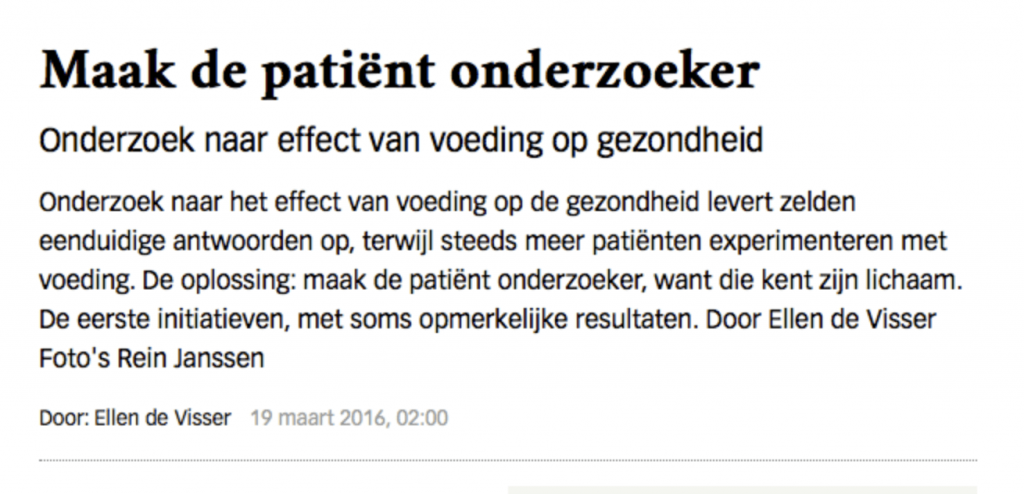
In the People's Side of Saturday, March 19 (read here) was finally addressing something I have been struggling with for many years - the limited usefulness of "hardcore" science in counselling clients.
Rather innocent experiments
By no means everything has been researched, much research is of limited use due to possible confounding variables and we are all different. Moreover, lifestyle adaptations involve turning many knobs at once, which science can do quite little with, as these usually examine the effect of only a single knob.
Counselling a client is about customisation (n=1) and this has little value in science as it is about large groups. In practice, however, all that matters is that the client feels better and gets rid of any physical complaints and discomforts. I would rather help a person get rid of his or her symptoms by trying innocuous things, than send the client home with no results based on science.

Pubmed shows new studies all the time
Thus, I have come to know an awful lot through "trial and error" in practice. One example is the effect of eliminating gluten. Many years ago, I noticed in practice that this can have positive effects in people with immunity problems and inflammation. At that time, the science behind this was still weak. Only celiac disease and wheat allergy existed.
Now in 2016, however, science is following my practice results. Pubmed is now full of studies on "glutensitivity" and "FODMAP" hypersensitivities, two new scientific findings, which probably explain effects I had long seen in practice. The harmless experimentation of today is the science of the future.
Science needs to do things differently
This is not a plea to jettison science. Certainly not, science must act differently in my opinion. For instance, I am surprised that no scientist has ever asked me what hormone factor colleagues and I have experienced in practice. There have been so many successes in a wide variety of complaints by thinking logically and starting quests with the client that this could be a great basis for scientific research.

In the internet age, you should be able to report this wonderfully, right? Worldwide, people with all sorts of complaints are trying things out on themselves and seeing connections. Get those results filled in on the internet. Get everyone who has come down from complaints to fill in what they did. If the number of people becomes very large then this is going to look more and more like science. It must be super, right, if you have migraines and see that (hypothetically) 8.2 per cent of people have fewer symptoms by avoiding caffeine and 4.3 per cent by eliminating old cheese? This greatly accelerates the personal quest and tends towards science.
Lifestyle interventions are usually so innocuous that I think we should be much less frenetic about them. That equine remedies such as drugs need to be incredibly well researched before using it makes sense to me, but should that also be the case if you start eating a bit more broccoli or replace wheat with oats? Not as far as I'm concerned...
So lifestyle coaches and dieticians: Dare to try things out and share your results! By doing so, we accelerate scientific progress and make many more people happy.
Ir. Ralph Moorman
 English
  Dutch
Dutch 