

With your shopping cart on supermarket safari!
What is a supermarket safari?
When a new client comes to me, I often take them to the supermarket to show them how to do 'healthy' shopping.
As you know, I prefer pure, honest, unprocessed products without chemical additives. Food that, with a little imagination, could also have been on the plate of our distant ancestors in the hunter-gatherer era. Of course, there are health food shops where you can go, but in practice most people prefer to go to the supermarket because of convenience and prices. Fortunately, more and more primal healthy products are appearing on the shelves there.
However, it is not always easy to identify products in the supermarket that fit into a healthy diet. During my tour, which I call 'supermarket safari' because of the many 'dangers' and temptations, I teach my clients where to find the pearls of health can find. I always go to the nearest branch of Albert Heijn or Jumbo because I know my way around there and there are plenty of healthy products available.
Explaining supermarket food
Before we enter the 'hunting ground', I explain that there are roughly two types of food products available in the supermarket.
Unprocessed food
First, there is nutrition as it directly from the source comes, such as vegetables, fruit, seeds, tubers, nuts, eggs, meat and fish. The products have been taken from the ground, picked from the tree or fished from the sea and transported to the supermarket without major processing. These are the safest foods, especially if they carry the European organic label.
Processed food
Second, there are the foods that via the factory have hit the shelves: tinned food, meat products, ready meals, margarine, sauces, soups, spice mixes, juices, cheeses, pre-fried products (biscuits, bread, jacket potatoes etcetera), marinated food, breaded food and so on. In short, foods that have been modified and 'improved'.
Sometimes certain processes can actually be beneficial and health-promoting, but often, unfortunately, the opposite is the case. These processed foods then do not fit within a healthy diet because, among other things, they contain chemical additives, sugar, trans fat, starch and cheap bulk raw materials in which there is very little nutritional value left.
Reading labels at Jumbo
To assess whether or not a processed food product is harmful to health, I always give a crash course in 'label reading' during the tour (often at a Jumbo since they are easy to cooperate). The packaging often states a 'nutrition declaration' and an 'ingredients declaration'.
When looking at the nutrition declaration, pay attention not so much to the calorie count as to the amount of carbohydrates, especially the heading 'of which sugars'. The less sugar, the better! In the 'fat' section, only saturated fats are listed separately. Unfortunately, it does not say here the amount of trans fat at. But while saturated fat is harmless, trans fats are very harmful to your health.
So you should be able to decide which products contain trans fats. Biscuits, cakes, industrial sauces and fast food products often contain hydrogenated fats. Hardening still creates some trans fats, so leave them out. In roasted nuts, the polyunsaturated fatty acids have been heated and so oxidised fats will have formed. Hands off!
On e-numbers and pseudonyms
Manufacturers are required to list the substances in the product on a label in order of quantity used. But sometimes there is something in the product that is not listed as such on the label anyway.
Especially with flavour enhancer E621 (vetsin), it is important to know the list of pseudonyms. An example. Yeast extract often contains E621. But if a food product contains yeast extract, only 'yeast extract' will be listed in the ingredient list, and not E621.... 'Yeast extract' in that case is a pseudonym for E621. Furthermore, pay attention to the allergen list on the packaging.
Also for your partner and children
Ultimately, it is important to consciously make your own compromise in the supermarket in terms of product choice. Especially if you also have to consider a partner and children at home. Obsession is not good, but being too casual often does not give you the body and health you are happy with either. My motto is: "Let everyone be their own guru." I tell you what I think is best for you, but you have to go with it yourself. Any improvement in your current diet is one.
Off to the organic shop
Most people with the hormone factor at first, they keep going to their usual "neighbourhood supermarket" out of habit, but gradually discover that they can get there faster if they walk a block to the organic shop. After all, there is a much larger and more varied range of healthy and 'clean' foodstuffs of high quality.
EkoPlaza is the organic supermarket where I do my shopping and also conduct a supermarket safari. Here I find the pure, unprocessed food that is best for my health. Organic food with the EKO or Demeter label assures me that I am more nutritional value for my money, because organically produced foodstuffs are generally richer in important nutrients than those from regular farming and ranching. Moreover, through organic food, I get fewer pesticides, chemical additives, antibiotics and genetically modified raw materials inside.
The environment
The list of factors that can disrupt health - diet, exercise, stress - includes a fourth factor that we unfortunately have less control over: the environment. Regular agriculture and animal husbandry use all kinds of chemicals that are harmful to health, substances that end up not only in food, but also in the soil, water and air.
It is important to reduce this form of environmental pollution. Food should be produced with respect for the environment, people and animals (!). Fortunately, more and more food producers are appearing who are acting responsibly.
EkoPlaza offers an extensive and select range of their products. But organic supermarket also applies: eat as much pure and unprocessed food as possible and watch the sugar content.
Demeter label
In EkoPlaza, in addition to products with the EKO label and the European organic label, you will also come across products with the stricter Demeter label. This concerns food originating from biodynamic arable and livestock farming, based on Rudolf Steiner's anthroposophical principles.
In terms of animal friendliness and sustainable business practices, among other things, Demeter goes further than EKO. For example, Demeter-approved products often come from mixed farms where the fields are fertilised with the manure of their own animals. The beaks of poultry and the horns of cows and sheep are always preserved. Products with the Demeter label can only be found in health food stores and health food shops.
Nutrition centre and traditional dietician
In my book 'The Grocery Coach', I write from the knowledge I gained while studying food technology at Wageningen University but I approach science as an applied biologist. This is a different scientific starting point from what the many 'nutritionists' who underpin the advice of the Nutrition Centre have.
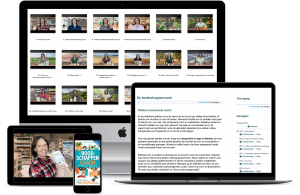
Want to know a lot more? Then follow the online course on supermarket food and learn the supermarket safari!
 English
  Dutch
Dutch 
7 Response(s), post a comment too!
When does the next safari start?
Greetings Cecile
Hi Cecile,
Thanks for your interest! We are assuming the end of November 2025. When there is more clarity I will send you an email.
Greetings
Fine, thanks.
I am waiting!
Greetings Cecile
Thank you,
Can you also tell me if a start time a date has been planned yet
Greetings lia
Hi Lia,
Thank you for your interest! The next group will start on Sunday 15 December.
hi hi,
The grocery coach this course is now only available online. So also enter any time?
What is the course like, videos etc.
I want to take this course after the holiday period.
Thank you happy healthy holidays
It can be followed online. There will be a kick-off moment and three live zoom moments. The rest you can watch yourself in the online environment with pre-recorded videos (there are pictures of those here to get an idea)....
gr Ralph