
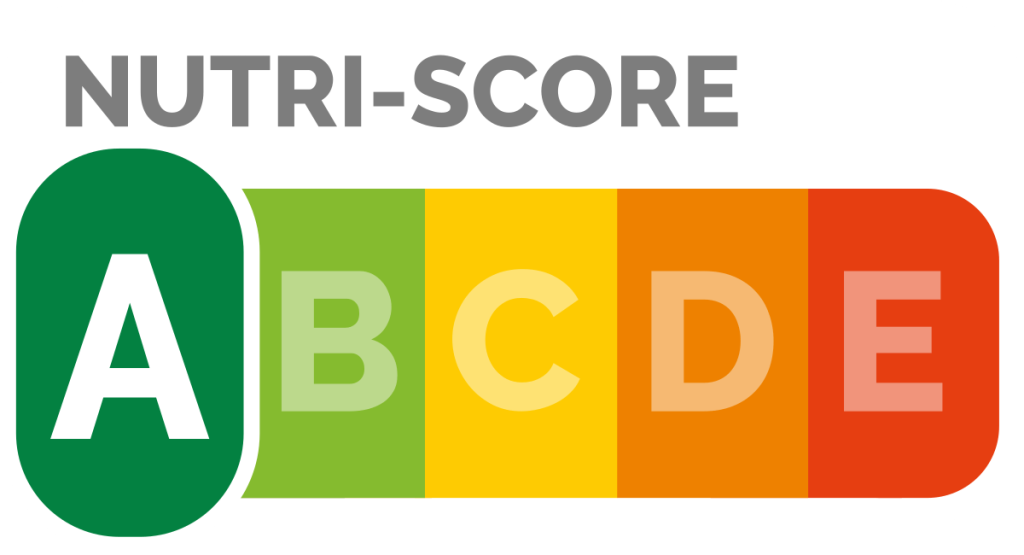
Briefly answer what the nutrient score is, its criteria, what it is useful for and the challenge to the five-slice diet.
What is the Nutri-score?
Nutri-Score is already used in several countries in Europe. Nedrland is introducing it from 1 January 2024.
What the purpose of Nutri-score is a bit unclear. It is presented as something to encourage consumers to buy healthier products, but the purpose behind this is also mainly to food companies of processed products to encourage them to put less sugar, salt, fat and calories in their products to get a good score. Personally, I think the second goal is fine, but the way it is done is not. In fact, I believe that for the first purpose (informing consumers), the Nutriscore logo is definitely not a clear and fair way of displaying the health value of products. Why I think so I will explain below.
What are Nutri-Score's criteria?
- The logo uses colours and letters to give a score about the product. Independent scientists developed this system.
- A product gets plus points for protein, fibre, fruits, vegetables, legumes, nuts.
- A product gets minus points for energy content (kcal), sugars, saturated fat, salt.
Based on the total score, a product is given an A, B, C, D or E. A dark green A represents the healthiest composition within the product group. Products with the least healthy composition are given a dark orange E.
Only usable for highly processed products
Op het eerste gezicht lijkt er best wat goed in te zitten, maar wat betekent dit in de praktijk? Extra vierge olijfolie zou geen A kunnen krijgen vanwege de calorie-dichtheid en een sterk bewerkt product vol zoetstoffen in plaats van suiker en smaakversterkers om zout te verlagen kan wel heel goed scoren. Bij zeer bewerkte producten is het misschien toepasbaar en nuttig, maar daarbuiten is de score verwarrend en vaak gewoon onwaar. Zo is verzadigd vet niet bewezen ongezond, energiegehalte zegt niets over verzadiging en de byeet factor, sugars depend on a context of fibre and fat in terms of blood sugar effect and salt is not necessarily bad and increases the follow-through factor only in processed snacks that include sugar and fat.
Is the Disk of Five the salvation?
There are many products from the Disk of Five that do not score well in the Nutri score. Think, for example, of milk products containing saturated fat. I will be interested to see how strong the Nutri-score lobby will be in the coming years. Will the Disk of Five be adjusted or will Nutri-score be abolished? Whether or not Nutri-Score will become and remain mandatory in the Netherlands will become clear.
 English
  Dutch
Dutch 