
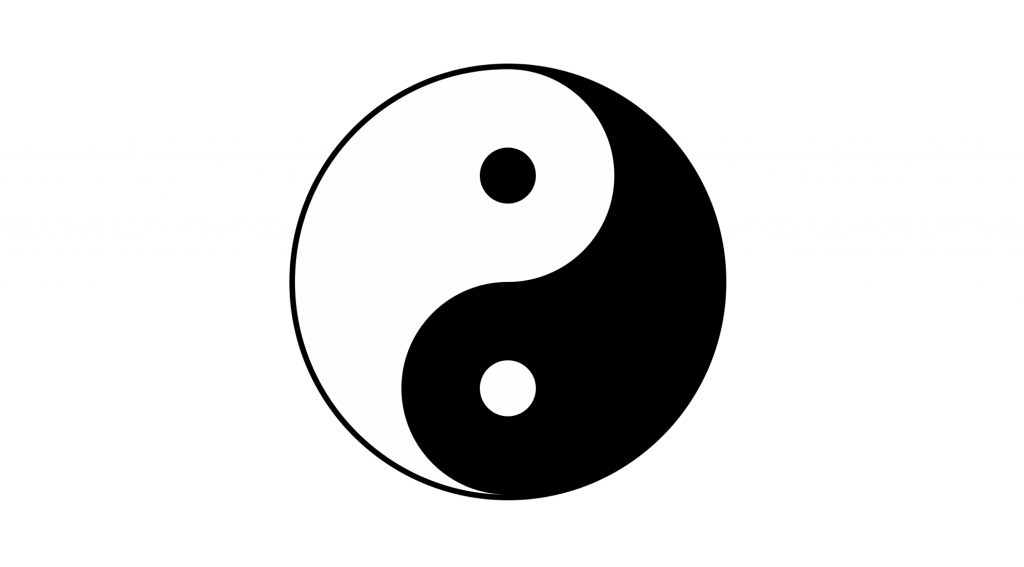
In this blog, I tell you more about how almost everything in the universe and in nature works. This phenomenon is better known as homeostasis or yin-yang (balancing). Everything consists of the opposites yin and yang in dynamic balance.
Yin-Yang, balance in the body
Many diets and health advice forget about yin-yang. This can cause this balance to go wrong in the long run. Through this balance, the body is able to anticipate a changing environment, activity, diet, sexual impressions etc.
Because of this mechanism, we survive and we see this everywhere in nature. This is something every health coach, personal trainer, doctor or therapist should take into account in their advice. Among other things, hormones, enzymes, neurotransmitters and energy are used by the body to activate yin and/or yang in response to the external and internal worlds.

Strength training
A nice example of this is strength training. In a workout, you actually break down some muscle (catabolic) and then trigger the body's counter-reaction to actually create muscle (anabolic).
If we provide the right training stimulus combined with the right nutrition and not too much stress (and overtraining), the balance may be more favourable. That is, we become more muscular after recovery. But even this is temporary! If we stop training then the environment changes. The extra muscle mass is redundant and the body will break down these muscles (catabolic). If the goal is gaining muscle mass, we influence the opposites that way. As a result, the balance tips towards more muscle mass.
For many people, 3 strength training sessions a week with 2 sets of 10 reps to overload works very well for a period of time. But even this training stimulus will not provide lasting results. When the body starts to recognise the stimulus and there is apparently no more reason to adjust muscle mass to it, it is time to start doing a different training schedule to reactivate the muscle-building counterpart. Among trainers, this is fortunately well known!
However, in the field of nutrition, for example, we often see the opposite and mistakes are made in the process. How often do people give very extreme advice where one antithesis so triggers the other that it must cause an unwanted counter-reaction. Below, I will mention some examples of advice that does not take yin-yang into account.
All food is healthy and unhealthy
With foods as a whole, there are an awful lot of substances that all perform different functions in the body. In current nutrition research, people often only look at a specific component from this food and not the food as a whole.
Even if a food contains some very healthy substances, we can never eat unlimited amounts of it. This is because it also contains unfavourable substances for health. That is why it is so brilliant of nature that there are so many substances and so many different food sources. As long as we add a lot of variety to our diet, the chances of excess and deficiency of a specific substance are the lowest. How logical it can be.
Every kind of organism strives to survive in nature. For example, a plant sometimes has substances that protect it from oxidation or fungi. If we eat this plant, these substances can also protect us from this. But of course, the plant must also protect itself from us, so that we don't eat all the plants and this species becomes extinct. You see this logic, for example, with plants that contain hormone-like substances, such as phytoestrogens. In small amounts, these substances can sometimes be good for our health, but if we were to eat too many of these plants, the plant logically tries to make us infertile with these substances. The plant does not die out because we do not reproduce indefinitely and therefore eat all the plants. A fine example of yin-yang logic in nature!
Extremely low-calorie diets
How logical is it that a body exposed to a severe energy deficit can do nothing but engage in a counter-reaction to survive.
An important means the body can use as a counter-reaction is the hormonal system. An example of this is thyroid hormone, which can lower the body's resting energy consumption by producing less thyroid hormone (free T3). The body will be able to easily restore the balance in the event of a short-term severe energy deficit. However, the risks become greater with a chronic calorie deficit. The body may then set a new balance (homeostasis).
If it calorie deficit is lifted, it may still not produce enough thyroid hormone (Wilson's syndrome). Thus, this diet can cause the metabolism to remain chronically slowed and one sometimes ends up even fatter than one already was. As a second mechanism, the body can also start triggering hunger to survive. Sometimes people then start eating more and may end up eating more than they would have done without dieting.
Protein diets
These days, diets are trendy where extremely low carbohydrates and sugars are eaten and, on the contrary, lots of protein. Again, the body does not accept this deficiency in the long run and the thyroid will slow down (free T3). These diets are also widely used by bodybuilders and fitness athletes and the symptoms of a slowed thyroid are sometimes quite visible.
Diets that avoid acidifying foods
Legumes, cereals, meat, fish, egg, dairy products are examples of foods that are said to be slightly acid-forming in the body. In these diets, these foods are discouraged as much as possible and the counterpart base-forming foods (leafy vegetables, fruits et al) are instead recommended. Again, this is an approach that takes a one-sided look at only one aspect of nutrition. Thus, in extreme form, a diet like this can lead to protein deficiency and too low a carbohydrate intake, with all its consequences.
High doses of dietary supplements
Some supplement consultants prescribe high-dose supplements for people to take throughout their lives. As with everything, there is an optimal balance for vitamins and minerals, for example. If there is an excess, the body will be triggered to excrete as much as possible. In addition, for substances that the body produces itself, the body can stop production.
There is a risk of overload especially with chronic use (with fat-soluble vitamins, for example). There is also a risk of developing a deficiency if these supplements are skipped for a while. This is because excretion is at maximum and the body has any of its own production on hold.
It seems natural to take in just a little less of these from time to time to give the body the trigger to solve this itself. Again, yin-yang applies here.
Stress
Too much stress is not recommended, but a dull life without a dose of positive stress is not optimal for health either.
Actually, in my recommendations, I look closely at humans in nature. Because our genes change so slowly and the environment, stress forms and diet change so incredibly fast, it seems logical to me that genes lag behind this. Between prehistoric times and now, how did humans live in yin-yang harmony with their environment? This strikes me as one of the most important things to spend research money on.
As I wrote above, giving health advice is just a bit more complex than replacing a worn-out part of a machine. Working multidisciplinary, keeping an overview and understanding yin-yang is the key strategy to arrive at the best possible advice and working with the body.
 English
  Dutch
Dutch 
1 Response(s), post a comment too!
Thank you this is very enlightening!